Why my children had time to study and time to play, and why I would do it the same way again
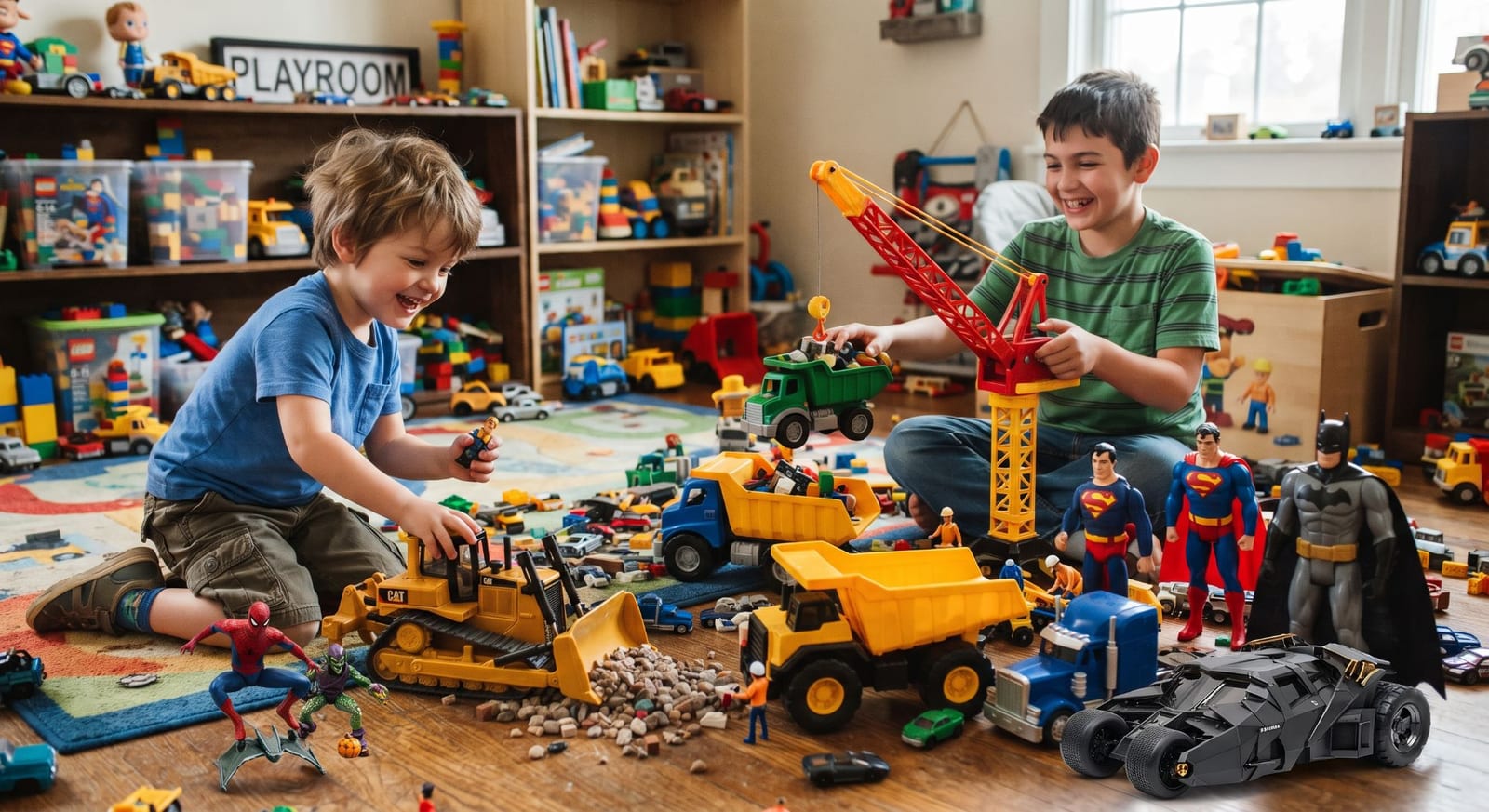
In our house, play came after homework. It never came instead of homework, but it always came.
That was the rule, and it was a simple one. School homework first. Then the Kumon worksheets. Then play. Nobody had to earn it with a perfect score. Nobody lost it because of an average grade. Once the work for the day was done, the rest of the afternoon belonged to them.
And there was plenty to play with. Race cars, police cars, trucks. Superman and Batman, ready to save somebody. They were the expensive kind of toys, and they were big, so the playroom was always crowded. There was almost no space left for everything, and somehow everything stayed.
A crowded playroom is not a problem. It is a sign that someone in the house is still a child.
The house rule
I did not invent this out of softness. I had taught both of them how to study from the week they started school: read it, understand it, write it down. Three encounters with the lesson, and then repetition. A child who studies that way does not need to sit at the table until nine in the evening. The work gets done because it is done properly, not because it is done for long.
The Kumon was not there because they were struggling. Neither of them was, not in Math or anywhere else. It was there for the habit: a little work every day, finished before anything else, so that finishing became normal.
So there was room left in the day. And I decided early that the room was theirs.
What the other parents were chasing
I know the other way of doing it. Many of us do.
The child who studies every waking hour so that he can be number one in class. The child who must bring home perfect scores in every exam. The medal on stage, the photo on the phone, the quiet competition among parents about whose child topped what. The honor of the family, carried on the shoulders of a ten-year-old.
I understand where it comes from. Most of it is love, and some of it is fear. But I never wanted my children to carry that. A child is not a trophy for the parents to bring to a gathering.
Though I will admit I was always grateful that my boys brought home the medal anyway. Nobody pushed them for it. It came on its own.
Why play is not wasted time
This is where the doctor in me has to say something.
Play is not the opposite of learning. It is one of the ways children learn the things school cannot teach them well. When children play, they practice taking turns, losing without falling apart, making rules and bending them, solving a problem nobody assigned. They are building attention and self-control, and they are building them happily. Pediatricians have been saying this for years, and some now go as far as to recommend play the way they would recommend sleep.
A child who is always at the desk is missing more than fun. He is missing practice.
What happens when childhood is skipped
Here is the part I have watched for a long time, as a mother and as a teacher of young adults.
Childhood does not disappear when you skip it. It waits.
Some children who were pushed to study without rest simply get tired. Somewhere along the way, in high school or in college, they stop. The engine that ran on pressure runs out, and there is nothing underneath it.
Others make it through. They finish college. They get the job. And then, finally free, they play. After office hours, on weekends, for years. At an age when they should be helping at home, doing their share of the chores, or enrolling in a postgraduate course to improve themselves, they are making up for the childhood they did not have.
I do not blame them. They are collecting what they were owed. But it is a strange time to be collecting it.
Good enough is good
My children are grown now. Both of them live in Manila and both of them are working. One has finished his master's degree. The other is about to begin his. Nobody forced them to go back to school. They went because the habit of studying never became a punishment for them, and so it never became something they needed to escape.
The bottom line in this life is not the medal. It is to finish school and to be able to earn a living.
So if your child is doing well in school, studying properly, and bringing home good or average scores, that is fine. That is enough. Do not ask for more than your child is capable of giving. Some children are built for the top of the class, and some are built for something else entirely, and both kinds grow up and find their way.
Give them the afternoon. Let them be loud in the yard for a while.
They will only be children once, and they are going to spend that childhood sooner or later.
Better sooner.
Comments (2)
I was raised the other way. I studied until late every night. I've been through everything you said (the comparing, honor roll, etc). I always thought I turned out fine. Then reading that childhood waits instead of disappearing finally explained my twenties to me. I spent my first three salaries on toys and figures I wasn't allowed to want as a kid. I'd game until 2am on work nights just because nobody could tell me to stop. I'll definitely let my daughter enjoy her childhood
Thank you for writing this. It takes something to say it out loud. And please notice the other half of it: you finished school, you have work, you were earning enough by your twenties to buy those figures yourself. The only measure that matters in the end is that you turned out fine. The toys and the 2 a.m. games were not a failure. They were a debt being collected. Your daughter is lucky. She will never have to pay it back, because you are giving it to her on time.
Leave a comment